writing advice

Touching the hand of God through watching birds

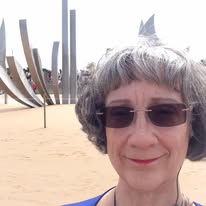
Janet on one of her many travels!

Please welcome my friend and sister writer, Janet Pierce!

Thanks for being with us today. First, would you tell us a bit about yourself? What area of the country do you live in, do you have a family, pets, etc.

I live in the eastern suburbs of Pittsburgh, PA with my husband. Occasionally our granddog Norman comes for a visit, with or without my grandsons. I have two sons, one lives in Cranberry, north of Pittsburgh with his wife and a mini-me, my granddaughter. My other son lives in the western suburbs of Pittsburgh with his wife, my two grandsons and Norman, the wonder dog- as my husband calls him.

Are you a coffee fiend, or do you have another “addiction” you must have on your desk at all times?

 I love coffee but it is not always at my desk. I may have water or tea, especially if it’s hot out or I have to do some talking with my critique groups.

Is your education relevant to your writing, or have you branched off in something entirely different to create? How would you best describe your books?

That’s an interesting question. I have written many different types of discourse. My very first attempt was when I was about 13. I was bored at our summer cottage after reading all the books I had brought with me, so I wrote The Carson Twins Mysteries- 2 of them. My twin sister illustrated them. They tell you to write what you know- so I wrote about twin sisters, used settings I was familiar with and mysteries which I loved to read at the time.

Years later, after getting my undergrad degree in Elementary Education and French, I couldn’t get a job in education right away. So, I wrote 2 children’s books for my sons, not published but now works in progress. Then I wrote and put on murder mysteries with my company Murder Most Mysterious. But after a year or two I found I did not like putting them on, I preferred to write them. So, I stopped that. While I was doing these things, I had my two sons. They even helped with the shows on occasion. Imagine having an 8- and 10-year-old in the cast. I was also writing and editing a weekly newspaper at the time. I enjoyed it but the money wasn’t very much. I also did free-lance feature stories for the Tribune Review during that time. I met a lot of interesting people for those stories. I loved doing the historical stories of people who had family members who did unusual things. As for myself I got a chance to go on a wagon train ride and found it fascinating. I rode in a surrey, a farm wagon and a Conestoga. I was in the surrey going up alongside a highway when a tornado went through the area. The sky darkened and wind howled. The horses formed a circle and turned inward. Luckily it did not come close to us.

Then as my writing job was being phased out at the newspaper, I managed to get a part-time teaching job. I taught English as a Second Language part-time while writing and then having to go to grad school to keep my teaching certificate. I had created my own double degree as an undergrad at Slippery Rock University and I ended up doing the same thing 28 years later at the University of Pittsburgh.

Eventually the reporting job ended, and I taught full-time. When PA said ESL teachers had to get an ESL certification, I was one of the few teachers who were able to get my certification through the creation of a work portfolio. I ended up teaching classes and developing online classes for the educating entities at the time. That led to my first self-published book- Teaching English Learners-Cultural Implications, Communications, Connections, and Curriculum. I also traveled up and down western PA teaching school district personnel how to create an ESL curriculum. In the 2000s I felt my job was threatened when another woman in my school district went back to school to get her ESL doctorate. So, I applied, was accepted and within 5 years, while teaching full-time, I got my PhD in English- Composition and TESOL. I actually graduated ahead of that teacher and was the oldest and first to finish in my cohort. I published articles in newsletters, and TESOL journals as well as having a chapter in one of their books- Revitalizing a Curriculum for School-Age Learners. I continued teaching until 2018 when I retired and decided to return to my first love- writing fiction. Now I am learning  another type of discourse.  I love history and researching so I use that in my fiction writing. I also love to watch birds at my bird feeders as I read or listen to my Bible.

Tell us about your most recent publication/whichever book you’d like to talk about today? 

My most recent publication is “Observations at the Bird Feeder, published the end of February.

image.jpeg

available  on Amazon https://a.co/d/0uVwo08

What inspired you to write this story? What interesting thing did you learn or research to write it that you didn’t know before?
I enjoy watching the birds that come to my bird feeder as I eat my breakfast and either listen to the Bible or read it. I started writing down my observations and how their actions reminded me of my own or other peoples’ reactions to things and then thought- “What does God think or say about this?” Having the app on my phone I was able to get key words and their scriptural basis as I wrote. I learned a lot of information about birds, and I learned a lot of scriptures. I was blessed to see these actions through both my eyes and the eyes of God as He talks in scriptures.

What’s your favorite thing about the book featured here today?

I am very pleased at how the book turned out, the pictures worked well and everything fell into place once I started getting it ready for publication.

Any special memories you have in the creation of it?

First of all, I never thought of these devotions as a book. It started as just a way to practice my writing skills, learn about birds and God. In one of my critique groups, I submitted a couple of them for our session and a woman told me, “You should get these published.” I asked the others what they thought. Now some of these woman were not overtly Christian and I didn’t even know if or what they believed so when they concurred, it was an Ah Ha moment. Of course, when I submitted the work to a couple of publishers, I was told it was too niche. That did not deter me. I finally decided to self-publish it. It is going well so far and I know a little bit about marketing (did I tell you I also worked in advertising for a very short time? ) but I try to remember, this book and the sales are my and my husband’s way of outreach, to others about how God is with us in all things and ways.

What do you most like about writing? I like imagining, and creating the stories, the writing and the research to learn more. Least like? Maybe doing the marketing, although I don’t hate it, it’s just that once more I have a lot to learn.

When did you first know you wanted to be an author? Well, I’ve always had something to say and I like writing, it is one thing I’ve always done well, albeit after learning a bit of how to write in a particular genre.

Do you belong to any writing groups?

Yes, I belong to Pennwriters, and to St. David Christian Writers.

Are there any writing websites you find particularly useful?

I have a few sites. I get links for Jane Friedman, Roseanna White, Reedsy, Authors Publish, Thomas Umstadt, and Writers Helping Writers.

Is there any special music you like to listen to while writing?

No, I really like silence, so I can get into my thoughts and just write with no distractions. 

How does it inspire you? It doesn’t when I am actually writing.

On my walks and driving the car, yes, Christian music does inspire me. I have written songs and performed them as I played guitar in my younger days. I still sing, but arthritis keeps me from playing guitar.

Do you belong to a critique group? What do you find most valuable about the experience? Yes, I belong to 2 critique groups- both online. I attend one that has helped me learn a lot about writing- POV, head-hopping, deepening tension are just a few of the things I’ve learned. I also run an online group that has members who have ebbed and flowed in and out from time to time. I wouldn’t mind running another one for Christian writers. I love doing it online too.

I drive to a Panera near me to meet with 3 other women who are Pennwriters and we discuss what we are doing, sharing pitfalls and encouragements.

To encourage those still on the path, tell us a little about your path to publication. Don’t give up. Join a critique group, read and learn about writing.  You can ALWAYS learn. Pray a lot and network. This is the advice I would give to any writer.

My path has been a winding, meandering one, over many years. I’ve had to be patient and be persistent.

How many books have you published? I self-published. My first one.-

image.jpeg

How many books did you write before selling one? What do you think was the key to selling that first book? When I designed the ESL courses for the state of Pennsylvania, I used the book for several of the classes. So they had to order and use it. Since there were no other books like mine, it was necessary. I have sold of 1,200 books in the past 20 years.

What are you writing now? I am currently working on my historical inspirational saga– Seasons: The Trevellian Family Saga.  There are to be 4 books in it. My agent is currently shopping the first one- Helena’s Autumn to publishers.

I also have an idea for another devotional. A pictoral book of the various things you see that reflect the wonder of God’s world on walks and what he has to say about them. The working title is- Walking in Wonder.

 What’s next for you—will you be making personal appearances anywhere our readers can find you? Yes. I may be doing a book crawl in Pittsburgh mid-May (details still to be worked out); I will be presenting at the Pennwriter’s Conference in Pittsburgh May 16-18th, and St. David Christian Writers in Meadville, PA  June 17-22ndat the Ohio Heritage Festival in Westerville Ohio August 16th, and a book signing August 24 at the Carpenter Loghouse in Boyce Park, Plum Borough, PA. I will also be at the Pennwriters Area 1 Road Trip in October 3-5.

Anything else you would like to add?

It has been an honor to talk with you and thanks for this opportunity.

You and everyone can reach me on my blog- https://www.janetpierceswritingcafe.com

And my author page on face book- https://www.facebook.com/JanetPierceAuthor

And on Instagram- https://www.instagram.com/jpierce494/

Never stop learning

PLEASE WELCOME MY GUEST LISABET SARAI!!!

Take it away, Lisabet!

My bio says that I’ve been writing all my life, and that’s pretty much true. I was penning stories and poems when I was in early elementary school. By high school I’d branched out to novels and plays. Though I’ve also done drawing and painting, sculpture and dance, words have always been my preferred instrument for creation. And to be honest, I grew up believing that I had significant writing talent.

The more I write, though, the more I realize how much I still have to learn.

Total-E-Bound, an English indie publisher focused on erotic romance, brought out the first edition of Getaway Girl way back in 2008. This was only my third or fourth tale written specifically for a romance audience. At that time, I knew almost nothing about the genre and its conventions. (Until I signed with TEB, I’d considered myself an author of erotica.) I spent quite a bit of time reading the work of my fellow TEB authors, trying to grasp the essence of this new category of fiction and to translate that into my own stories. My editors also did not hesitate to point out areas where common aspects of erotica just wouldn’t work for romance readers.

By 2008 I’d concluded that in every romance: 1) there had to be a sense of inevitability to the connection between the hero and heroine, an attraction that might seem to make no sense but which could not be denied; 2) the couple had to at least discuss commitment; 3) the sex (this was erotic romance after all) had to be more than just casual – there should be a sense of fitting or rightness, a connection that transcended the physical.

I tried to implement these conclusions in writing of Getaway Girl. The story was accepted and published, but was never particularly popular. I went on to write a lot more romance, getting better at it over time.

Last year I reclaimed the rights to the story so that I could self-publish it, and a few months ago I set myself the task of re-editing the piece in preparation. I really hadn’t looked at it for more than a decade.

I was appalled by how clumsy and stereotyped it seemed.

Inconsistencies in character and in plot were only part of the problem. There were also long passages of purple prose, most especially in the sex scenes. I posted the tale in my critique group and discovered there were also plentiful anachronisms and inaccuracies related to its historical period (contemporary) and British setting. (The story was originally targeted for an anthology entitled Bound Brits, so it had to take place in the U.K.)

I subjected the story to possibly the most thorough revision I’ve ever done on any of my work. I won’t say that it’s unrecognizable, but I probably modified at least 25% of the text. In the fourteen years since the first revision I’ve learned a lot, both about romance and about writing in general. Practice does make perfect; I’ve published nearly one hundred titles since that early attempt, both romance and erotica. This second edition of Getaway Girl is orders of magnitude better than the original.

But maybe I shouldn’t use the word “perfect”, because in truth, as long as we authors are writing, we are learning all the time. I’m about to revisit my first novel, preparing an expanded twenty-fifth anniversary edition for release sometime this year. This will be the fifth version of Raw Silk. I have no doubt it will be the best.

Our story:

Be careful what you wish for

All Peg wants is a break, a bit of adventure, a relief from her mundane existence in the bucolic but boring Yorkshire hamlet of Kirkby Malzeard. When dashing, sophisticated journalist Lionel Hayes saunters into the pub where she’s tending bar, Peg suspects that he was just the sort of man to fulfill her fantasies of escape.

The seductive Lionel, however, is not what he seems. Before she knows it, Peg is a hostage, roped and gagged, speeding away from the scene of a daring crime. Lionel is armed and dangerous, but somehow Peg still wants him – regardless of the consequences.

Note: This book was originally published in 2015 by Totally Bound. This second edition has been substantially revised and has a new ending.

EXCERPT:

“What are you doing here, if I might ask?”

“Me? Oh, I’m a journalist. I’m doing a story on the find and its historical implications.”

Peg felt a twinge of suspicion. “The press conference was yesterday.”

“My car broke down halfway from London. I spent last night in a town even tinier than this one.” His smile was charming, apologetic. Peg’s uneasiness melted away.

He leaned towards her across the bar, putting his hand over hers. “That’s why I appreciate your help, in giving me the information I need.”

His skin was warm and smooth, none of the calluses of a manual labourer. Not like the farmers Peg had occasionally dated here, before she gave up on finding a man in her home village. He ran one fingertip up and down in the sensitive crease between Peg’s thumb and forefinger. The light touch was enough to turn her nipples to aching knots and trigger a throbbing between her legs.

She caught a hint of his scent, a balsam-laced aftershave or cologne that simultaneously conveyed masculinity and refinement. His forefinger ventured higher, stroking the back of her wrist, a gesture both delicate and bold. Her pussy clenched as though he were massaging her down there, instead of merely brushing a casual finger across her hand.

She stared at the bar, blushing, angry with herself for being so susceptible. Finally, she managed to raise her head and meet his eyes, which were a stormy hazel colour.

“What paper are you from?”

“Oh, I write for an upmarket travel rag. I doubt that you would’ve heard of it. This story should enhance the romance and mystery of your already delightful village. I expect you’ll see a surge in tourists after publication.”

“You should interview Peter Lofthouse. He’s been mayor for the last dozen years.”

“I have the feeling that I’m talking to a real authority right now. Lived here a long time, haven’t you?”

She bristled. How did he know that? Maybe because she seemed such a country bumpkin. “I spent some time in London, but I had to come back. Family problems.”

“Sorry to hear that…” He scanned her chest, seeking a name tag. Peg felt as though he were fondling her breasts instead of just looking at them. Could he see the swollen tips, pushing up through her soft green jumper?

“I’m Peg,” she said, snatching her hand from his and reaching for the bar rag. “And you?”

He bowed slightly. “Lionel Hayes, at your service. But I’ll bet you’re really Margaret, right? It’s much more musical, more sophisticated. It suits you.”

He was clearly trying to flatter her. She didn’t really mind. “Lionel—sounds like an aristocratic playboy from the nineteen twenties. Nobody’s named Lionel anymore.”

The journalist laughed again, soft and intimate, sending the blood rushing again to Peg’s cheeks as well as to other body parts. He drained the last of his pint, then reclaimed her hand. “I’ve got to go. But it’s been pleasure to meet you, Margaret. Perhaps I’ll mention you in my article.”

Buy Links

Kinky Literature – https://www.kinkyliterature.com/book/1587-getaway-girl-/

Amazon US – https://www.amazon.com/dp/B0D2WM4BXR

Amazon UK – https://www.amazon.co.uk/dp/B0D2WM4BXR

Smashwords – https://www.smashwords.com/books/view/1557686

Barnes and Noble – https://www.barnesandnoble.com/w/getaway-girl-lisabet-sarai/1103185498

Kobo  – https://www.kobo.com/us/en/ebook/getaway-girl-10

Apple Books – https://books.apple.com/us/book/x/id6499560218

Add on Goodreads – https://www.goodreads.com/book/show/212364347-getaway-girl

Add on BookBub – https://www.bookbub.com/books/getaway-girl-by-lisabet-sarai-2024-05-03

About Lisabet

Lisabet Sarai became addicted to words at an early age. She began reading when she was four. She wrote her first story at five years old and her first poem at seven. Since then, she has written plays, tutorials, scholarly articles, marketing brochures, software specifications, self-help books, press releases, a five-hundred page dissertation, and lots of erotica and erotic romance – over one hundred titles, and counting, in nearly every sub-genre—paranormal, scifi, ménage, BDSM, LGBTQ, and more. Regardless of the genre, every one of her stories illustrates her motto: Imagination is the ultimate aphrodisiac.

You’ll find information and excerpts from all Lisabet’s books on her website (http://www.lisabetsarai.com/books.html), along with more than fifty free stories and lots more. At her blog Beyond Romance (http://lisabetsarai.blogspot.com), she shares her philosophy and her news and hosts lots of other great authors. She’s also on Goodreads, BookBub and Twitter. Join her VIP email list here: https://btn.ymlp.com/xgjjhmhugmgh


Could it be I’m a real writer?

Most days, I write for a few hours, or edit. That makes me feel like a writer. With coffee.

But today has been different.

I started out reviewing my email, and found a request for cover art for my manuscript SIXSHOOTER, so I had to fill out descriptions for the three main characters and return them to the editor, along with the contract for the science fiction romance book.

I also got a request to approve my course description and contract for a class I’m teaching for Pennwriters this fall on writing sci-fi and fantasy.

Then I got the video book trailer I’d ordered for my romantic suspense book TENDER MISDEMEANORS, with a request for approval. It was fantastic! I’ll post it on the TM page here in a few days.

THEN I got a request to approve the schedule for two classes I’m teaching at the Flathead River Conference in Montana in October, one on writing series, and one on world-building.

THEN I got a five star review from Long and Short Reviews for ADVERSARIES, the third book in my Color of Fear series.

I haven’t even started writing yet!

Is this what authors’ days are really like? I’d like a lot more of them, please! 🙂

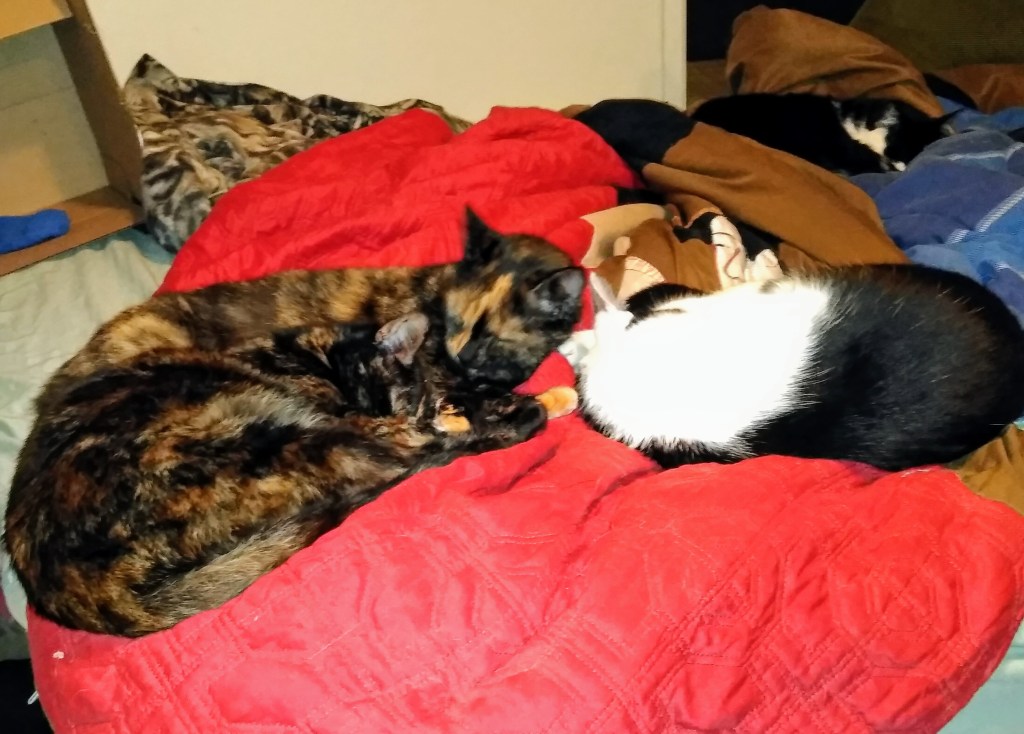
Meanwhile, I will share with you our flavor mix of the day–two torties with a topping of tuxedoes. 🙂

Some writing advice…is less than perfect ‘good enough’?

 Today’s entry is from Randy Ingermanson, the ‘Snowflake Guy’.

IMG_20180720_165918081I’ve got to say that I’m of various opinions on this. Depends where my piece is going next.
If it’s a contest, where THIS IS IT, I tend to lean toward perfection. If it’s going to a beta reader or an editor, I want it to be good, of course, but I think it’s important to let go of perfection in favor of getting some other eyes on it and opening up.

Organization: Is “Done” Better Than “Perfect”?

by Randy Ingermanson

I realized recently that I’m a perfectionist.

That has an upside and a downside.

The upside is that when I finally finish something, it’s the best I can do. It’s something I can be proud of.

The downside is that it often takes me a very long time to finish things. And sometimes I don’t get them done at all. And that means there are a lot of unfinished things on my plate. Which is not something to be proud of.

So I’ve been asking myself lately whether it’s better to be “done” or “perfect.”

And I can’t see that either one is always the best answer.

The Argument to Just Get it Done

Some things simply don’t need to be perfect. (That’s very hard for me to say, but I have to admit it’s true.)

I own a couple of acres of land, in a state where there’s lots of rain and quite a bit of sunshine. Which means that weeds grow like crazy here. Short of a nuclear blast, I don’t think it’s actually possible to get the entire lot free of weeds at any given time.

But even if it was possible, they’d be back in a week. So it makes sense to just blaze through and knock out all the big weeds and leave the little guys alone. Painful as it is to let the little weeds live, there are just too many of them.

Now that summer is approaching, I’m facing that reality again. So there’s a case for getting the job mostly done, rather than perfectly done.

I had a manager once who used to say, “Make it good enough for now.” I never liked that idea, but often it was the only way to work.

When you have a hard deadline that absolutely must be met, usually the best you can do is “good enough for now.”

The Argument to Get it Perfect

But there are times when you really need perfection.

For example, when lives are at risk. Every airplane crash is a reminder that somebody, somewhere wasn’t perfect.

As another example, sometimes there are outsized rewards for being the best. If you’re IMGP0717.JPGan Olympic athlete in an event that gets a lot of media attention, there can be a huge financial difference between a gold medal and a silver. Even if the performance difference is only a hundredth of a second.

When you’re in a high-risk situation or a high-reward situation, “good enough for now” really isn’t good enough.

What About That Book You’re Writing?

Let’s bring this home for writers. What about that book you’re writing? Is it better to get it done, or get it perfect?

I’d say that depends.

It depends on what your goals are for the book. It depends on your strategic vision for your writing career.

It may very well make sense for you to write books quickly, doing the best you can in a set amount of time, producing good quality books on a regular schedule. That works for many writers. We might call this the James Patterson model. Mr. Patterson does very well by writing about a dozen books per year.

But it may also make sense for you to write the best book you possibly can, no matter how long it takes. You might take years between books, while your fans loyally wait, knowing that you’re going to give them an amazing experience every time. That also works well for some writers. We might call this the J.K. Rowling model. The last three Harry Potter books were spaced two to three years apart. And Ms. Rowling has done very well by that model.

You Get To Decide

You are in charge of your own life, so you get to decide how you’ll run your writing career.

Remember, it’s not all or nothing. You don’t have a binary choice between “fast and good enough” or “slow and perfect.” There’s a spectrum of options, and you get to choose where you’ll fit on that spectrum.

IMGP0748Here are a few questions to guide you:

  • Does your personality lean more towards “get it done” or “get it perfect”?
  • Does your target audience value high speed in writing or high quality?
  • Are there outsized rewards for being the fastest writer in your category?
  • Are there outsized rewards for being the best writer in your category?
  • Where do the writers you admire most land on the spectrum of “fast” versus “amazing”?

Every project is different. You don’t have to put all your books at the same point on the spectrum. You can bend some of them toward the “fast” end and some toward the “amazing” end.

I make only one recommendation here: make the decision on where you want your book to be on the spectrum at the beginning of the project.

And then live by that decision.

******

This article is reprinted by permission of the author.

Award-winning novelist Randy Ingermanson, “the Snowflake Guy,” publishes the free monthly Advanced Fiction Writing E-zine. If you want to learn the craft and marketing of fiction, AND make your writing more valuable to editors, AND have FUN doing it, visit http://www.AdvancedFictionWriting.com.