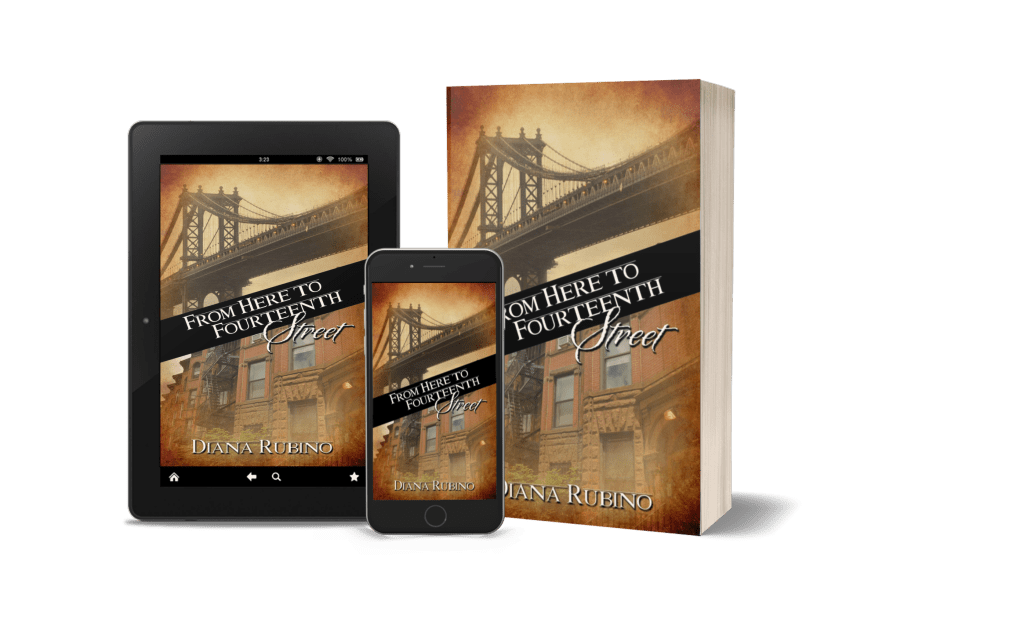
FROM HERE TO FOURTEENTH STREET from author DIANA RUBINO
Now on Audio with the soothing voice of narrator Nina Price
Read About FROM HERE TO FOURTEENTH STREET and how Vita Found Love and Success Against All Odds
It’s 1894 on New York’s Lower East Side. Irish cop Tom McGlory and Italian immigrant Vita Caputo fall in love despite their different upbringings. Vita goes from sweatshop laborer to respected bank clerk to reformer, helping elect a mayor to beat the Tammany machine. While Tom works undercover to help Ted Roosevelt purge police corruption, Vita’s father arranges a marriage between her and a man she despises. As Vita and Tom work together against time and prejudice to clear her brother and father of a murder they didn’t commit, they know their love can survive poverty, hatred, and corruption. Vita is based on my great grandmother, Josephine Calabrese, “Josie Red” who left grade school to become a self-made businesswoman and politician, wife and mother.
An Excerpt:
As Vita gathered her soap and towel, Madame Branchard tapped on her door. “You have a gentleman caller, Vita. A policeman.”
“Tom?” His name lingered on her lips as she repeated it. She dropped her things and crossed the room.
“No, hon, not him. Another policeman. Theodore something, I think he said.”
No. There can’t be anything wrong. “Thanks,” she whispered, nudging Madame Branchard aside. She descended the steps, gripping the banister to support her wobbly legs. Stay calm! she warned herself. But of course it was no use; staying calm just wasn’t her nature.
“Theodore something” stood before the closed parlor door. He’s a policeman? Tall and hefty, a bold pink shirt peeking out of a buttoned waistcoat and fitted jacket, he looked way out of place against the dainty patterned wallpaper.
He removed his hat. “Miss Caputo.” He strained to keep his voice soft as he held out a piece of paper. “I’m police commissioner Theodore Roosevelt.”
“Yes?” Her voice shook.
“I have a summons for you, Miss Caputo.” He held it out to her. But she stood rooted to that spot.
He stepped closer and she took it from him, unfolding it with icy fingers. Why would she be served with a summons? Was someone arresting her now for something she didn’t do?
A shot of anger tore through her at this system, at everything she wanted to change. She flipped it open and saw the word “Summons” in fancy script at the top. Her eyes widened with each sentence as she read. “I can’t believe what I’m seeing.”
I hereby order Miss Vita Caputo to enter into holy matrimony with Mr. Thomas McGlory immediately following service of this summons.
How FROM HERE TO FOURTEENTH STREET Was Born
New York City’s history always fascinated me—how it became the most powerful hub in the world from a sprawling wilderness in exchange for $24 with Native Americans by the Dutch in 1626.
Growing up in Jersey City, I could see the Statue of Liberty from our living room window if I leaned way over (luckily I didn’t lean too far over). As a child model, I spent many an afternoon on job interviews and modeling assignments in the city, and got hooked on Nedick’s, a fast food chain whose orange drinks were every kid’s dream. Even better than the vanilla egg creams. We never drove to the city—we either took the PATH (Port Authority Trans Hudson) train (‘the tube’ in those days) or the bus through the Lincoln Tunnel to the Port Authority Bus Terminal.
My great grandmother, Josephine Arnone, “Josie Red” to her friends, because of her abundant head of red hair, was way ahead of her time. Born in 1895 (but it could’ve been sooner, as she was known to lie about her age), she left grade school, became a successful businesswoman and a Jersey City committeewoman, as well as a wife and mother of four. She owned apartment buildings, parking garages, a summer home, did a bit of Prohibition-era bootlegging, small-time loan-sharking, and paid cash for everything. When I began outlining From Here to Fourteenth Street, I modeled my heroine, Vita Caputo, after her. Although the story is set in New York the year before Grandma was born, I was able to bring Vita to life by calling on the family legends and stories, all word of mouth, for she never kept a journal.
Vita’s hero Tom McGlory isn’t based on any real person, but I did a lot of reading about Metropolitan Policemen and made sure he was the complete opposite! He’s trustworthy and would never take a bribe or graft. I always liked the name McGlory—then, years after the book first came out, I remembered that was the name of my first car mechanic—Ronnie McGlory.
Changing the Title
When I proposed the story to The Wild Rose Press, I wanted to change the title, as it went through so many revisions since it was first published. I wanted to express Vita’s desire to escape the Lower East Side and move farther uptown. I considered Crossing 14th Street, but it sounded too much like Crossing Delancey. After a few more hits and misses, the title hit me—as all really fitting titles do.
A Bit of Background—What Was 1894 New York City Like?
The Metropolitan Police was a hellhole of corruption, and nearly every cop, from the greenest rookie to the Chief himself, was a dynamic part of what made the wheels of this great machine called New York turn.
The department was in cahoots with the politicians, all the way up to the mayor’s office. Whoever wasn’t connected enough to become a politician became a cop in this city. They were paid off in pocket-bulging wads of cash to look the other way when it came to building codes, gambling, prostitution, every element it took to keep this machine gleaming and efficient. They oiled the machine and kept it running with split-second precision. The ordinary hardworking, slave-wage earning citizen didn’t have a chance around here. Tom McGlory and his father were two of a kind, and two of a sprinkling of cops who were cops for the right reasons. They left him alone because he was a very private person; he didn’t have any close friends, he confided in no one. He could’ve made a pocket full of rocks as a stoolie, more than he could by jumping in the fire with the rest of them, but he couldn’t enjoy spending it if he’d made it that way. They knew it and grudgingly respected him for it. He was here for one reason–his family was here. If they went, he went. As long as they needed him, here he was. Da would stop grieving for his wife when he stopped breathing. Since Tom knew he was the greatest gift she gave Da, he would never let his father down.
Meet Vita: An Interview With Vita Caputo, Heroine of FROM HERE TO FOURTEENTH STREET
Vita, we know you and Tom overcame astronomical odds to stay together. It’s like Romeo and Juliet. I can imagine how torn you felt when you wanted to be with Tom, but didn’t want to defy your father. Tell us, what was your family and homelife like when all this was going on?
Well, I loved my father and brothers more than anything, and didn’t want to defy them. Yet at the same time, I felt they weren’t respecting my wishes. I was in love with Tom, and they hated him for two reasons, which to me, were irrational—he’s Irish and he’s a cop. But you have to understand their underlying reasons—cops always gave Italian immigrants a hard time on the Lower East Side. They didn’t give Italians a fair shake. Many of them were bullied, arrested for crimes they didn’t commit—and of course if you know my story, you know that the police framed Papa and my brother for the murder of Tom’s cousin, also a cop. I can understand their hatred of the police force for this heinous act. But not the entire police force is corrupt. Teddy Roosevelt, the Commish, certainly wasn’t, and Tom certainly isn’t. But when you face this hatred and injustice every day, it’s easy to be bitter. Our homelife, before I met Tom, was the usual Italian household—we struggled to make ends meet and didn’t have much, but I always made sure we had more than enough to eat, and to share with those who had less. I went without new clothes, shoes, coats, to buy groceries so we wouldn’t go hungry. We argued over petty things—like who left the stove on—but we always made up in the end. We were very affectionate, and gave each other a lot of hugs and kisses. We sometimes felt the world was against us—and at times it was.
What did your childhood home look like?
Did you ever see the classic Jackie Gleason sitcom The Honeymooners? They had a walk-up flat in Brooklyn. Well, ours was on Mott Street in Manhattan, but our flat looked much like that—it was called a ‘railroad flat’ because all the rooms were in a row—kitchen sitting room, bedrooms in back. We shared a toilet on the landing. But compared to other Mott Street tenements, we had it made—we had indoor plumbing. No bathtub, but a sink with running water. We didn’t have to go to a backyard privy. The bedroom was partitioned off by a curtain that I’d made—one side was mine, the other side my brother’s. Papa and his wife Rosalia had another bedroom to themselves.
What is your greatest dream?
To be a Senator or Congresswoman, but I’m happy enough as a committeewoman for now.
What kind of person do you wish you could be? What is stopping you?
I wish I could be calmer and slow down. I do too much—run the household because I refuse to hire help, raise our 3 kids, work and invest our savings. I follow the stock market and purchase stocks that have long-term growth potential. What’s stopping me is my drive to get ahead.
Who was your first love?
Tom, of course. My father tried to throw me together with ‘a nice Italian boy’ Roberto Riccadonna whose family owned a music store and was ‘well off’ – but he was arrogant and controlling. He threatened me when I told him I wasn’t interested in him. He and Tom got into fisticuffs when I found Roberto under my boardinghouse window singing “O Sole Mio” with a mandolin. He had a nice voice, but Tom was hardly impressed.
What’s the most terrible thing that ever happened to you?
When Papa and my brother Butchie were arrested for the murder of Tom’s cousin Mike. It tore me into pieces, because Tom didn’t want to believe Papa and Butchie were the killers, but evidence pointed to them. We made it our quest to find the real killer, and we did. It created a huge rift in our relationship of course, but we overcame that as we got through all the other hardships and prejudices that tried to keep us apart.
What was your first job?
I started out as a sweatshop worker sewing ‘shirtwaists’ (blouses), and now I’m a committeewoman, with a view to being New York City’s first female mayor.
What’s your level of schooling?
I left school at 16 to go to work in a lampshade factory.
Where were you born?
Sassano, Italy, near Naples.
Where do you live now?
Greenwich Village, in a brownstone on East 14th Street.
Do you have a favorite pet?
They’re all favorites, two mongrel pups, Charlie and Shirley, two cats Romeo and Juliet, and assorted goldfish whose names we can’t keep up with!
What’s your favorite place to visit?
Coney Island, to sit on the beach, frolic in the ocean, eat those delicious hot dogs and fried dough, and stroll the boardwalk!
What’s your most important goal?
To see my three children become successful, respectable citizens. Doing all right so far—my daughter Assunta (Susan) owns a clothing store, my son Virgilio (Billy) writes Broadway musicals and my youngest Teresa (Tessie) wants to be a baby doctor.
What’s your worst fear or nightmare?
That the stock market will crash again or some other disaster will plunge us back into poverty.
What’s your favorite food?
My homemade lasagna with my grandmother’s sauce recipe (it’s a secret)
Are you wealthy, poor, or somewhere in between?
We’re finally members of the solid middle class.
What’s your secret desire or fantasy?
To sing in one of my son’s musicals.
What would you do if you won the lottery?
I’d buy my own airplane and give the rest to charity.
A Review From Romantic Times:
Immigrant Vita Caputo escapes New York’s Italian ghetto and secures a job in a Wall Street bank, along with a room in a Greenwich Village boarding house, thanks to Irish police officer Tom McGlory. With her new beginning, Vita even joins the Industrial reform movement.
Tom is an honest cop, with little interest in women until he meets Vita. When Tom’s cousin is murdered and Vita’s father and brother are arrested for the crime, the two team up to investigate and soon discover that they are falling in love.
Vita and Tom face economic problems, prejudice, and cultural differences. Ms. Rubino’s research is obvious.—Kathe Robin
From Rhapsody Magazine:
FROM HERE TO 14th STREET by Diana Rubino is all that and then some. Everything about this book is what writing should be–original and wonderfully executed. Bravo!—Karen L. Williams
From Book Nook Romance Reviews:
Diana Rubino has done a masterful job of researching the life of Italian and Irish immigrants in turn-of-the-century New York, its society and politics and crime. She paints a vivid picture of the degradation immigrants of Italian descent suffered, particularly at the hands of the earlier Irish immigrants they succeeded. Barred from all but the most menial jobs, forced to live crammed into the worst slums, she makes it easy for the reader to understand why many of them turned to a life of crime and violence. Not only can the reader see what Vita and Tom see, they can smell it, hear it, and taste it.
Vita is a delightful heroine, as full of vivid life as the city she lives in. Stubborn, determined to escape the ghetto in which she lives and make something of herself, she never loses her commitment to and love for her family. That very devotion, however, threatens her growing relationship with Tom, since the Irish and Italians are the Capulets and Montagues of 19th century Manhattan. Although she cannot help falling deeply in love with him, she knows that her father and brothers will never permit her to spend her life with him. And, in a departure from the usual super-masculine hero, Tom is a sensitive, secret poet as well as a cop.
If you like vivid characters and a book that carries you effortlessly back to an earlier time, FROM HERE TO 14th STREET is a good choice. –Elizabeth Burton
| MORE ABOUT THE LOWER EAST SIDE: One fascinating place to visit is the Lower East Side Tenement Museum at 97 Orchard Street, once an actual tenement. They have tours describing life as it was back then, with each floor of the building decorated (if you want to call it ‘decorated’) to depict each time period when immigrants lived there. I read a lot of books to research this story. One book I remember reading as a kid is How The Other Half Lives by Jacob Riis, a photographer and reformer of the time. The photos in his 1901 book vividly illustrate the poverty and deprivation of the times, for adults and children alike. |
ABOUT ME:
My passion for history and travel has taken me to every locale of my stories, set in Medieval and Renaissance England, Egypt, the Mediterranean, colonial Virginia, New England, and New York. My urban fantasy romance, FAKIN’ IT, won a Top Pick award from Romantic Times. I’m a member of Romance Writers of America, the Richard III Society and the Aaron Burr Association. I live on Cape Cod with my husband Chris. In my spare time, I bicycle, golf, play my piano and devour books of any genre.
The historical monarch I’d most like to meet is Richard III, my favorite of all time.
Visit me at www.dianarubino.com, www.DianaRubinoAuthor.blogspot.com, https://www.facebook.com/DianaRubinoAuthor, and on Twitter @DianaLRubino.
Purchase FROM HERE TO FOURTEENTH STREET
Keywords: New York, Romantic Thriller, Historical Romance, Victorian era, Italian Immigrants


 Alana Lorens, author